
Magnesium, explained
What magnesium does, how much you need, which foods carry the most, how the supplement forms differ (glycinate and bisglycinate included), and how much is too much.
- What magnesium does
- How much you need
- Best food sources
- Who may run low
- The different forms
- Glycinate vs bisglycinate
- What studies say
- Safety and too much
- Common questions
What magnesium does in your body
Magnesium helps more than 300 enzyme systems do their work, including those that make energy, build protein and keep muscles and nerves working.
The US National Institutes of Health (NIH) describes magnesium as a cofactor in more than 300 enzyme systems. A cofactor is a helper an enzyme needs to work. Through these systems, magnesium takes part in:
- making energy from food
- building protein
- muscle and nerve function
- building bone, DNA and RNA
- moving calcium and potassium across cell walls, which matters for nerve signals and muscle contraction
Where magnesium is kept
An adult body holds about 25 grams of magnesium. Around 50 to 60% of it is in the bones, and most of the rest is in soft tissues such as muscle. Less than 1% is in the blood.
Because so little is in the blood, a normal blood test does not always show how much magnesium the body has overall. The body uses its stores, the gut and the kidneys to keep the blood level within a narrow range.
How much magnesium do you need?
The amount depends on your age and sex, and it goes up a little in pregnancy.
Most adult women need about 310 to 320 mg a day and most adult men about 400 to 420 mg a day, from food and supplements together.
These are the US Recommended Dietary Allowances (RDA), the daily amount that covers the needs of nearly all healthy people.
| Age | Male | Female | Pregnancy | Breastfeeding |
|---|---|---|---|---|
| Birth to 6 months | 30 mg* | 30 mg* | ||
| 7 to 12 months | 75 mg* | 75 mg* | ||
| 1 to 3 years | 80 mg | 80 mg | ||
| 4 to 8 years | 130 mg | 130 mg | ||
| 9 to 13 years | 240 mg | 240 mg | ||
| 14 to 18 years | 410 mg | 360 mg | 400 mg | 360 mg |
| 19 to 30 years | 400 mg | 310 mg | 350 mg | 310 mg |
| 31 to 50 years | 420 mg | 320 mg | 360 mg | 320 mg |
| 51 years and over | 420 mg | 320 mg |
* For babies, the figure is an Adequate Intake, the amount that breastfed babies normally get. Source: NIH.
The Malaysian figures
Malaysia's Recommended Nutrient Intakes (RNI 2017), published by the Ministry of Health, base their magnesium figures on these same US recommendations. The Malaysian upper limit for magnesium from supplements is also 350 mg a day for adults.
The best food sources of magnesium
Seeds, nuts, green leafy vegetables, beans, soy foods and whole grains are the richest sources.
Magnesium sits in the green pigment of plants (chlorophyll), which is why dark green leafy vegetables are good sources. Seeds, nuts, beans and whole grains are also rich in it. Refining grains removes much of the magnesium, so whole grains carry more than white flour or white rice.
Magnesium per serving
Amounts are from the NIH food table (US data); 28 g is about a small handful. The Malaysian RNI (2017) noted that local food composition tables did not list magnesium. The body typically absorbs about 30 to 40% of the magnesium in food.
Easy ways to eat more
- Add a spoon of pumpkin seeds or chia seeds to oats, yoghurt or a salad.
- Keep a small handful of almonds, cashews or peanuts as a snack.
- Choose brown rice, wholemeal bread or oats over white rice and white bread more often.
- Add spinach or other dark leafy greens to soups, stir-fries and omelettes.
- Use beans, tofu, tempeh, edamame or soy milk in meals during the week.
Who may not get enough magnesium?
Healthy people rarely run seriously low, because the kidneys hold on to magnesium when intake is low. But some groups are more likely to fall short.
The NIH names four groups more likely to be low in magnesium. If you are in one of them, ask your doctor before changing your diet or starting a supplement.
People with gut conditions
Long-term diarrhoea and poor fat absorption in conditions such as Crohn's disease or coeliac disease, and some bowel surgery, can lead to low magnesium over time.
People with type 2 diabetes
Higher sugar levels in the kidney appear to increase urine output. That extra urine can carry more magnesium out of the body.
People with alcohol dependence
Magnesium deficiency is common. It is linked to poor diet, stomach and gut problems, and more loss through the kidneys, among other causes.
Older adults
With age the gut tends to absorb less and the kidneys lose more. Older adults also tend to get less magnesium from their diet and are more likely to take medicines that affect it.
Signs of low magnesium
According to the NIH, early signs of low magnesium can include loss of appetite, nausea, vomiting, tiredness and weakness. When it becomes more severe, it can cause numbness, tingling, muscle cramps and other serious problems.
These signs have many other causes. Only a doctor can tell you whether magnesium is the reason.
Magnesium supplement forms: what is the difference?
Supplement labels list magnesium as oxide, citrate, chloride, malate, L-threonate, glycinate, bisglycinate and more.
Every form is magnesium joined to a partner. The magnesium is the same; the partner gives each form its name and its own properties.
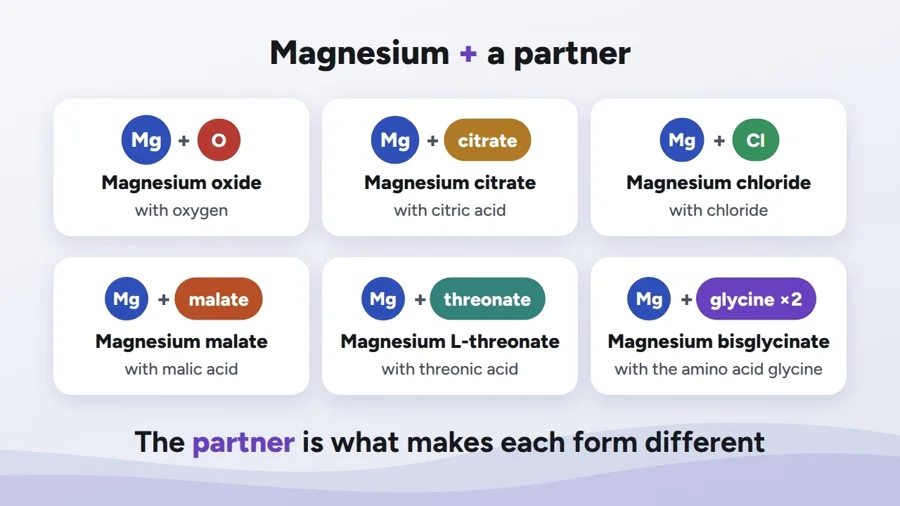
Magnesium oxide
A simple mineral salt that does not dissolve well in water.
Magnesium citrate
The partner is citric acid, the acid in citrus fruit.
Magnesium chloride
Dissolves easily in water, unlike oxide.
Magnesium malate
Its partner, malic acid, is found in fruits such as apples.
Magnesium L-threonate
A newer form, added to the EU list of forms allowed in food supplements in 2025.
Magnesium bisglycinate
Magnesium held by two molecules of glycine, the smallest amino acid. Also sold as "magnesium glycinate".
Other forms you may see
- Magnesium hydroxide is used in medicines: as a saline laxative for occasional constipation and as an antacid for heartburn.
- Magnesium carbonate, lactate and sulfate are salts on the EU list of supplement forms.
- Magnesium aspartate is magnesium with the amino acid aspartic acid.
- Magnesium taurate pairs magnesium with taurine, and is on the EU list of supplement forms.
- Magnesium orotate is magnesium with orotic acid. It is not on the current EU list of forms allowed in food supplements.
What is a chelate?
Bisglycinate is a chelate (say "KEE-late"). The word comes from the Greek for a crab's claw, because each glycine grips the magnesium at two points.
Magnesium glycinate vs bisglycinate
Magnesium glycinate and magnesium bisglycinate are the same compound with two names.

"Bis" means "two". One magnesium atom joins two glycine molecules. Each glycine holds the magnesium at two points, at an oxygen and at a nitrogen, which makes two small rings.
PubChem, the US National Library of Medicine's chemistry database, lists "magnesium glycinate", "magnesium bisglycinate" and "magnesium diglycinate" as names for one compound, formula C₄H₈MgN₂O₄. PubChem uses "magnesium glycinate" as the main title. The European Union's list of forms allowed in food supplements uses "magnesium bisglycinate".
Read more: Magnesium glycinate vs bisglycinate (and other forms)
Which form is best? What the studies say
The evidence is mixed. There is no large human trial that compares all the forms against each other, so no form has been proven best.
Forms that dissolve well
The NIH notes that forms that dissolve well in liquid are absorbed more completely than less soluble forms. Small studies found the aspartate, citrate, lactate and chloride forms were absorbed more completely than magnesium oxide and magnesium sulfate.
Magnesium oxide
In a 2001 study in healthy volunteers, oxide was absorbed poorly compared with chloride, lactate and aspartate. Glycinate was not part of that study.
Glycinate vs oxide
A small 1994 study in 12 patients who had part of their small bowel removed found that, on average, glycinate and oxide were absorbed about the same. Glycinate did better only in a subgroup of 4 patients who absorbed oxide worst. The result may not apply to everyone: the group was very small, and all the patients had undergone bowel surgery.
A 2025 lab study
A Polish team tested many products in a model of digestion. In this study, simple mineral salts such as chloride and oxide generally did better than organic forms such as citrate and lactate. Bisglycinate was the exception among the organic forms and scored close to chloride. This was done in test tubes, not in people, and it goes against some of the human studies above.
Magnesium L-threonate
The claims about raising magnesium in the brain come mainly from studies in rats. One human trial in 44 adults looked at memory tests, not brain magnesium, and its authors were linked to the company that developed the form.
Read more: Which magnesium form is most absorbable?
How much is too much? Safety and medicines
Magnesium from food is safe for healthy people, because the kidneys remove any extra. Supplements need more care.
Adults should keep magnesium from supplements and medicines to no more than 350 mg a day unless a doctor advises otherwise. This is the upper limit used in Malaysia and the US.
The upper limit
The NIH lists these upper limits for magnesium from supplements and medicines; Malaysia's RNI uses the same 350 mg for adults. They do not include magnesium from food and drinks.
| Age | Upper limit |
|---|---|
| Birth to 12 months | Not set |
| 1 to 3 years | 65 mg |
| 4 to 8 years | 110 mg |
| 9 to 13 years | 350 mg |
| 14 years and over | 350 mg |
The adult limit of 350 mg also applies in pregnancy and while breastfeeding.
Side effects
High doses of magnesium from supplements or medicines often cause diarrhoea, sometimes with nausea and stomach cramps. The forms most often reported to cause diarrhoea are magnesium carbonate, chloride, gluconate and oxide.
Serious magnesium overload is rare. It has been linked to very large doses of magnesium-containing laxatives and antacids, typically more than 5,000 mg a day. The risk is higher in people whose kidneys do not work well, because the kidneys remove extra magnesium.
Magnesium and medicines
- Osteoporosis medicines (bisphosphonates): magnesium can reduce how much of the medicine is absorbed. Take magnesium at least 2 hours before or after them.
- Some antibiotics (tetracyclines and quinolones): take the antibiotic at least 2 hours before, or 4 to 6 hours after, a magnesium supplement.
- Water pills (diuretics): some types make the body lose more magnesium in the urine; others make it keep more.
- Stomach acid medicines (proton pump inhibitors, PPIs): taken for a long time, usually more than a year, they can lower magnesium levels.
- Zinc: one study found that very high zinc doses from supplements (142 mg a day, far above usual amounts) reduced magnesium absorption.
Common questions
Are magnesium glycinate and magnesium bisglycinate the same?
Yes. They are two names for the same compound: one magnesium held by two glycine molecules. See Chapter 6.
Which magnesium form is the best?
No form has been proven best in large human trials. Forms that dissolve well in water have done better than oxide in small human studies, but the evidence is mixed. See Chapter 7.
Can I get enough magnesium from food?
Many people can. Seeds, nuts, green leafy vegetables, beans, soy foods and whole grains are rich sources. See Chapter 3.
How much magnesium from supplements is too much?
For adults, the upper limit used in Malaysia and the US is 350 mg a day from supplements and medicines, not counting food. Too much often causes diarrhoea. See Chapter 8.
Can I take magnesium with my medicine?
Some medicines need to be taken a few hours apart from magnesium, and some change how much magnesium the body keeps. Ask your doctor or pharmacist. See Chapter 8.
Does a blood test show my magnesium level?
Only partly. Less than 1% of the body's magnesium is in the blood, and the body keeps the blood level steady, so a normal result does not always reflect the body's total stores. See Chapter 1.
Key points
- Magnesium helps more than 300 enzyme systems, including those for energy, protein, muscles, nerves and bones.
- Most adult women need about 310 to 320 mg a day and most adult men about 400 to 420 mg, from food and supplements together.
- Seeds, nuts, green leafy vegetables, beans, soy foods and whole grains are the richest food sources.
- Every supplement form is magnesium joined to a partner. Glycinate and bisglycinate are the same compound.
- Studies comparing the forms are small, and some are lab-only. No form has been proven best.
- Keep magnesium from supplements within the upper limit, and ask a health professional if you have a kidney condition or take regular medicine.
This guide is general information, not medical advice.
Sources
- NIH Office of Dietary Supplements. Magnesium: Fact Sheet for Health Professionals (updated 6 January 2026). ods.od.nih.gov
- National Coordinating Committee on Food and Nutrition. Recommended Nutrient Intakes for Malaysia 2017, Chapter 25: Magnesium. Ministry of Health Malaysia. hq.moh.gov.my
- PubChem. Magnesium glycinate, CID 84645. US National Library of Medicine. pubchem.ncbi.nlm.nih.gov
- Directive 2002/46/EC on food supplements, Annex II: forms of minerals allowed (consolidated version of 26 November 2025). eur-lex.europa.eu
- Commission Implementing Regulation (EU) 2025/2225, adding magnesium L-threonate (Official Journal copy). www.boe.es
- MedlinePlus. Magnesium hydroxide. US National Library of Medicine. medlineplus.gov
- Firoz M, Graber M. Bioavailability of US commercial magnesium preparations. Magnes Res. 2001;14(4):257-62. pubmed.ncbi.nlm.nih.gov
- Schuette SA, Lashner BA, Janghorbani M. Bioavailability of magnesium diglycinate vs magnesium oxide in patients with ileal resection. JPEN. 1994;18(5):430-5. pubmed.ncbi.nlm.nih.gov
- Bawiec P, et al. In Vitro Evaluation of Bioavailability of Mg from Daily Food Rations, Dietary Supplements and Medicinal Products from the Polish Market. Nutrients. 2025;17(5):748. pmc.ncbi.nlm.nih.gov
- EFSA NDA Panel. Safety of magnesium L-threonate as a novel food. EFSA Journal. 2024. doi.org
- Slutsky I, et al. Enhancement of learning and memory by elevating brain magnesium. Neuron. 2010;65(2):165-77. pubmed.ncbi.nlm.nih.gov
- Liu G, et al. Efficacy and Safety of MMFS-01, a Synapse Density Enhancer, for Treating Cognitive Impairment in Older Adults. J Alzheimers Dis. 2016;49(4):971-90. pubmed.ncbi.nlm.nih.gov
- Spencer H, et al. Effect of zinc supplements on the intestinal absorption of calcium and magnesium in adult males. J Am Coll Nutr. 1994;13:479-84. pubmed.ncbi.nlm.nih.gov